
Limited Stock: Who Gets Less, and How Much Demand Goes Unmet?
When supply runs short, allocating stock leaves customers with fewer items, while the quantity they originally ordered leaves no record.

Conceptual illustration. The case is real; company details are disguised.
Customer orders have come in, but supply from farmers or suppliers is not enough to fill them all. Customers still receive their orders, only in smaller quantities. In a food distribution business, this allocation of stock happens before goods are prepared at the Depo, the place where goods are stored and customer orders are prepared.
The decision on who receives less has to reach the team preparing the goods on time. The originally ordered quantity also has to stay on record. If the records follow only the latest quantity, the demand that went unmet disappears once the stock has been allocated. Both needs meet in the same process.
The decision sits with the Sales Manager: customers with large purchases and a good payment record come first, while stock allocation reduces the quantity for customers with small or infrequent orders, or late payments. In the old process, the sales admin then opened the Depo's Google Sheet, changed the order quantity directly in the cell, and told the Depo team manually.

The problem appeared when the preparation sequence did not follow the new decision. Orders that were worked on first had already been prepared in full. An allocation meant to reduce the quantity for regular customers ended up reducing it for priority customers. The decision had been made, but the result on the ground could be reversed because the change had not reached the preparation process.
The second problem is not visible from the Depo floor. Because the number is overwritten, the original order quantity is lost with it. The worksheet shows only the latest quantity, with no record of unmet demand. The record keeps the number of items to be prepared, but not the size of the customer need left unserved because of limited supply.
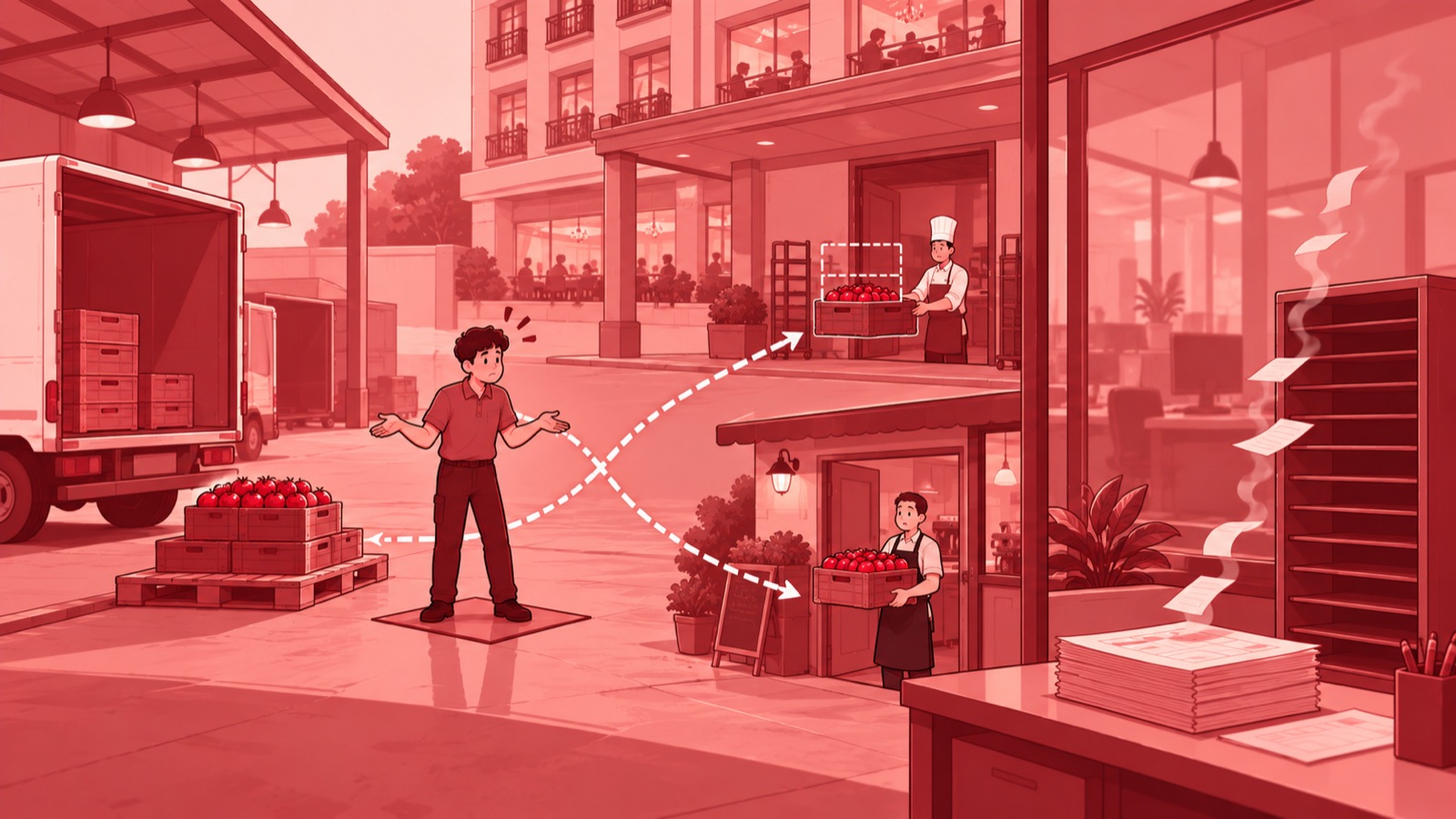
As head of the IT Division, I worked with the team to move stock allocation into the system. I moved the place where the decision is carried out, not the decision itself, because the Sales Manager knows the customer types and looks after those relationships. The Sales Manager still decides which customers get less. The design rests on one principle: every change in quantity must change the work that follows and leave a record at the same time.
The flow now runs in sequence. The purchasing team tells the sales team that supply is short. The Sales Manager decides which customers get less. The sales admin changes the quantity through the stock allocation menu, under the Sales Manager's supervision. From the system, the change is passed straight to the preparation team at the Depo, with no manual word-of-mouth step.
For the preparation sequence, the priority status of a customer is stored in the customer data. The preparation screen offers a choice of Regular or Priority, so priority orders are prepared first. The priority rule is the same as in the manual period. What changed is the execution: the preparation team uses the marker stored in the system when working on orders according to the stock allocation.

The new flow went into use in March 2023. At the start, users were guided through running the stock allocation process in the system. The guidance took place alongside daily work and tapered off once usage problems stopped appearing.
Every stock allocation also goes into an order quantity change report. The original quantity and the quantity after allocation remain visible side by side. The value of unmet demand is calculated from the difference between those quantities, using the selling price for the customer concerned. The report can be filtered by date, Depo, and division. It shows the customer, the order quantity, the quantity after allocation, and the Depo's production quantity. Records are kept per event, so any discussion of supply limits has clear order details as its basis.
This flow has run since March 2023, and sales records for March to August 2026 still contain unmet demand. The records make that need visible, while meeting it still requires a procurement decision. The planned follow-up is to bring this data to a procurement meeting with sales leadership and the purchasing team, then use it regularly as a basis for procurement decisions.
My lesson: a stock allocation decision must reach the next piece of work without erasing the original demand. That way, the quantity prepared follows the decision, and the unmet demand stays visible afterward.