
When Stock Accuracy Depends on One Person
The stock numbers were available, but explaining how they changed meant searching from one date's worksheet to the next.
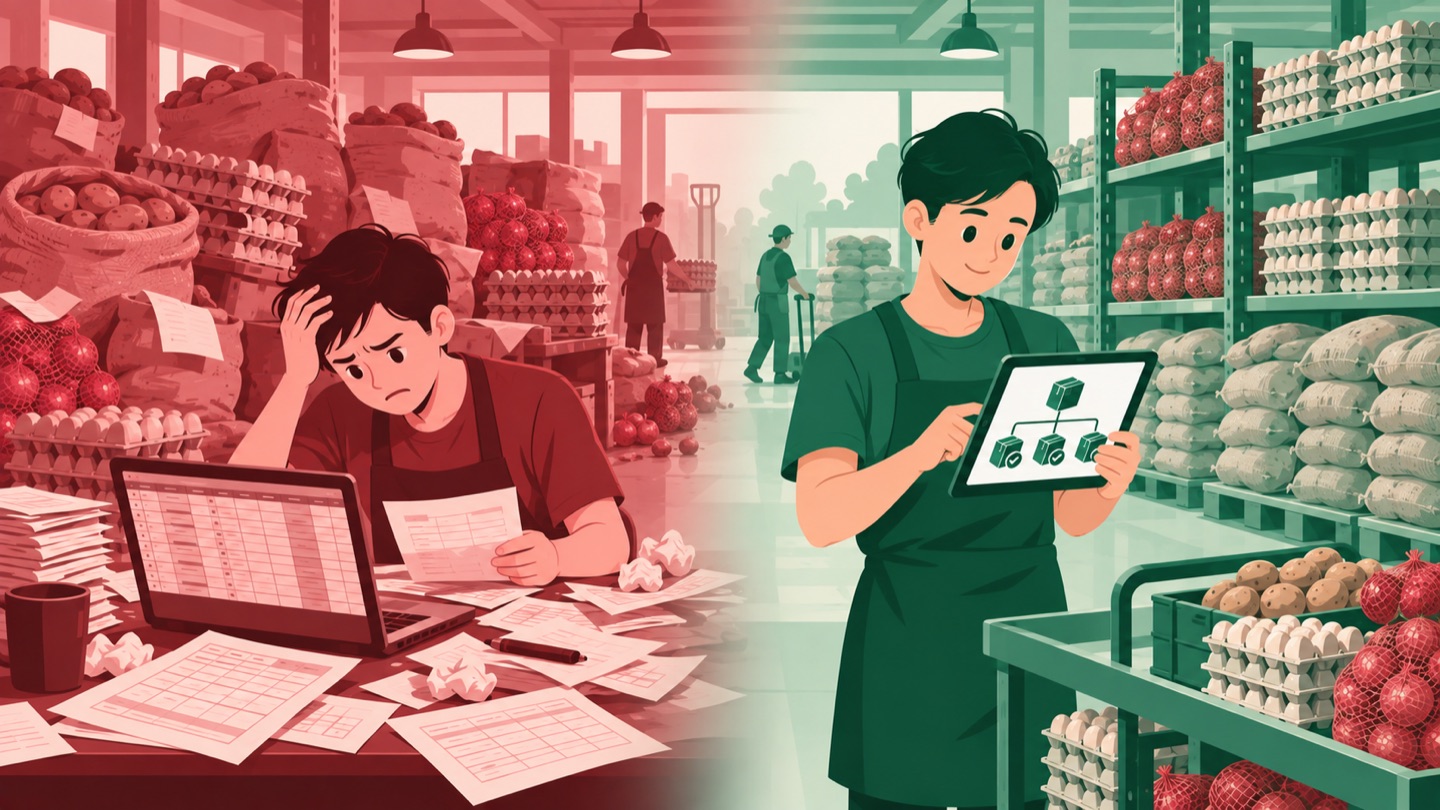
Conceptual illustration. The case is real; company details are disguised.
Are you facing a similar situation? If the person who keeps the stock records is out, how does anyone else know and check what the real stock is? For a business owner, it is also a question of how far inventory information can be relied on when it depends on one person.
In this fresh-produce supply chain operation, inventory used to be recorded in Google Sheets, organized by date and category. Admins compiled goods received, adjustments, discarded goods, returns, and changes in the form of goods. To trace the journey of a single item, staff had to open worksheets from different dates and search for its records by hand.

The difficulty arose when the stock quantity changed but the reason for the change was not recorded in a structured way. Adjustments could be written in a free-text column. Whoever reviewed the records had to understand how the worksheet was laid out. In the end, tracing depended on the maintainer who knew where and how each change was recorded.
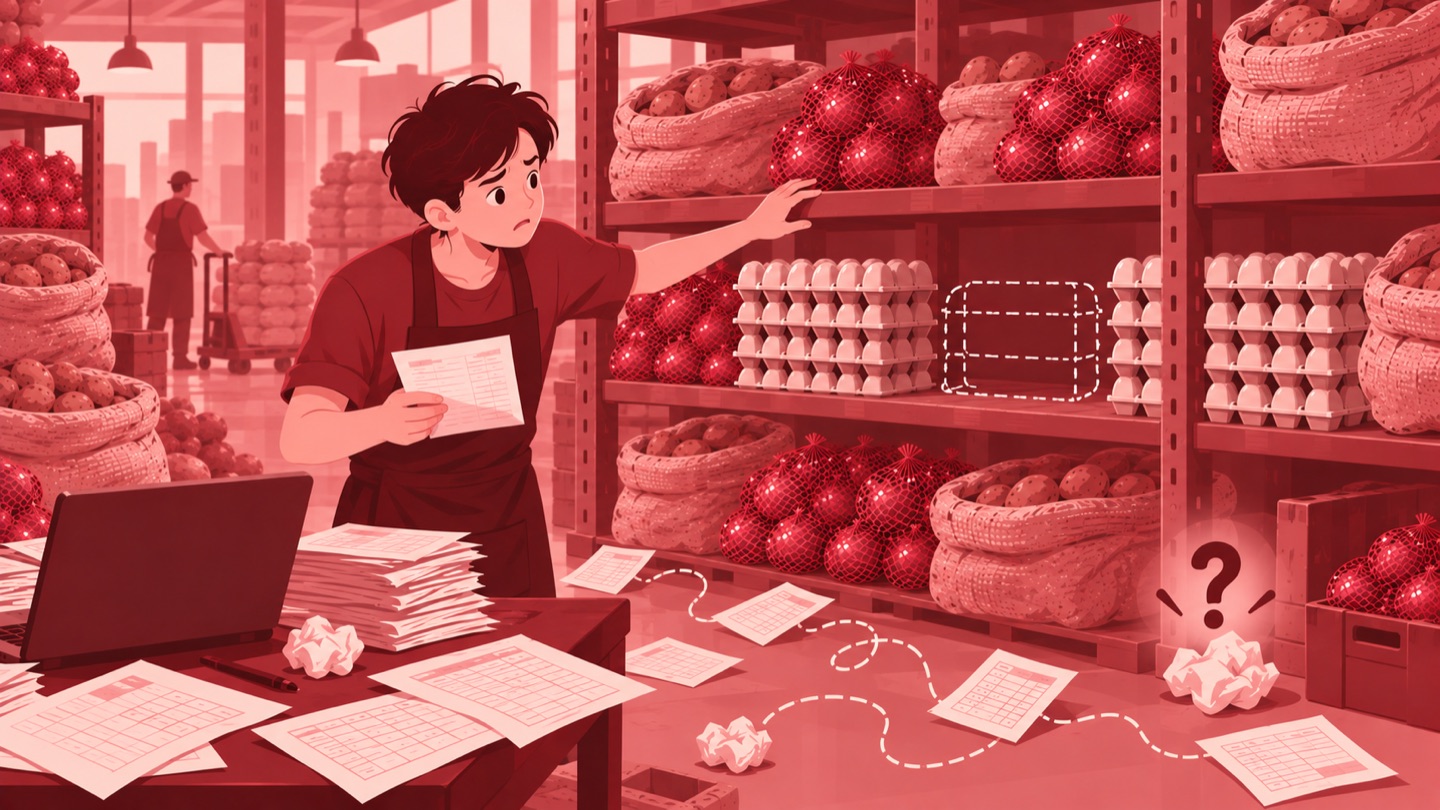
Changes in the form of goods show this problem concretely. Whole turmeric processed into peeled turmeric used to be recorded as separate outgoing and incoming adjustments. Both records represented the same process, but recording them this way left room for quantity errors in each adjustment.
Returns raised a different problem. Returned goods are not necessarily all damaged. When returned goods were not recorded back as inventory, goods that could still be used risked being treated as discarded. The records needed to distinguish the condition of the goods so the reason for a stock change could be understood.
The weakness lay in how records were kept, not in who held them. The worksheet is like a book written by hand. The numbers in it can change without a recorded type or reason, and if a number is wrong, the company bears the risk.
Incoming stock was not tied to its origin either: at the Depo, the warehouse where goods are received and stored, incoming goods were compiled manually, receipts were recorded separately, and reports were put together again.
In my view, a consistent procedure can only be enforced by a system. As head of the IT Division, I set one rule as the core: incoming stock comes only from recorded receipts, and outgoing stock comes from the goods production records. The IT team built the system that enforces it.
Stock changes outside that rule, such as adjustments and discarded goods, are recorded together with their type and reason, not just the number, so that every change in quantity can be explained later.
Processing goods, for example whole turmeric into peeled turmeric, is now recorded as one paired movement, not two adjustments that can each be wrong in quantity. The IT team limited the choices to registered pairs of goods, so that wrong selections can be prevented.
Returns are split into two categories, because not all returned goods are damaged. Goods that can still be used go back into inventory, while damaged goods are recorded as discarded goods. The Depo assesses the condition of the goods and chooses the category.
The incoming-stock rule is enforced directly: receipts are recorded in the same system as the stock, so stock increases as soon as a receipt is recorded. Reports are generated from that data and are no longer put together again.
The system also follows the nature of the fresh-goods business. Goods are produced at night to be delivered in the morning, so there are no transfers between Depos. Because of that, the transfer feature that had been prepared in an early version was not continued.
I brought the principle of separating the person who records from the person who checks from my previous work experience, and the board of directors and Finance approved it because it fits sound control practice. The Depo records; Finance, outside those who carry out the recording, checks.
Every month, the results of the physical count are uploaded to the system and Finance verifies every difference. Once the results are final, the system stock is adjusted to match the physical count, and recording errors are corrected.
The monthly review of discarded goods aims to find possible recording mistakes so they can be corrected. Losses with no evidence of a recording mistake are reported to management through the profit and loss statement.
Changing habits from a free worksheet to a binding procedure was not easy for the Depo team. The change took hold because the Depo team's work also became easier, especially purchase planning and restocking, since the movement of goods was already recorded.
To trace a single item, the reviewer now opens its history over a chosen date range, instead of going through worksheets date by date.
The result answers the problem at the start: every change in a number now leaves a trace of its type, reason, and history. To know the real stock, the system's records still need to be compared with the physical count.
The question at the start of this piece can now be answered from the records, not from one person's memory. If the person who records is absent, another reviewer can open the item's history, see the type and reason of each change, then compare it with the physical count.

For me, the lesson from this change is that a system helps provide a trail of changes, while people remain responsible for recording and checking them.
This inventory history later became the basis for forecasting purchasing needs.